It’s Only Natural
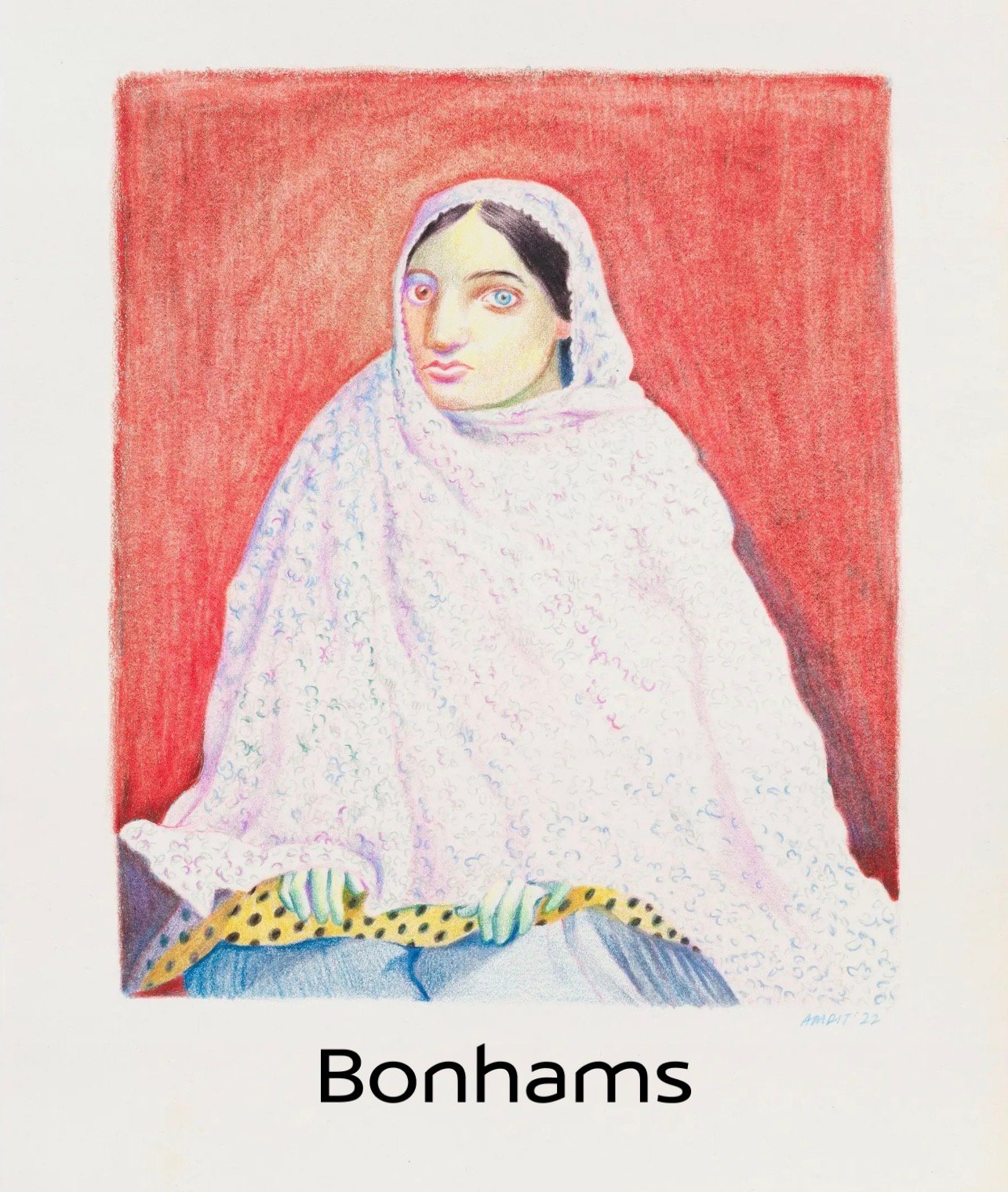
The Modern & Contemporary South Asian department at Bonhams, in collaboration with curator Vittoria Beltrame, is pleased to announce a second exhibition, It’s Only Natural, presented as part of our Modern and Contemporary South Asian Art auction on 2 June 2026.
Drawing on Roland Barthes’ Mythologies (1957), which proposes that images are never as simple as they seem, this exhibition considers how contemporary practices break down and rethink myths embedded within tradition and cultural memory. If myth, as suggested by Barthes, transforms history into something that appears natural, the works included in this selection resist and rework this perception, by unsettling inherited narratives too often read as fixed - resulting in an understanding of an identity always in shift, layer upon layer.
Across painting and drawing, Amrit Singh Sandhu, Divya Balivada, and Shumaiya Khan approach the image not as a simple representation, but as re-imagination. Their works do not only depict identity, but they also reveal how it is constructed, through inheritance and experiences, while simultaneously challenging the attempt to stabilise it.
In Amrit Singh Sandhu’s practice, the image is stretched across the surface. Archival photographs, often understood as truth of memories, are reworked disrupting their authority. Here, the familial image so often mythologised as an anchor of origin becomes speculative. Sandhu exposes the myth of belonging, replacing it with a continuous process of becoming shaped by diasporic movement.
Divya Balivada’s work engages with another type of myth: the internalised and culturally coded image of the self. Her works often hover between figuration and dissolution, representing abstract bodies and gestural movements that resist legibility. Balivada disrupts coherence, playing with the idea that identity, particularly feminine identity, can be fully seen, known, or categorised. Instead, her paintings operate in ambiguity, where perception is redefined and meaning is altered. This happens on the canvas while reworking memories of natural environments that have shaped not only her years of moving and replanting roots, but from this, her entire persona too. It is not merely of inspiration, it is indeed embedded in her.
Shumaiya Khan instead extends this destabilisation into the visceral. Her tactile abstract surfaces draw on animism and mysticism, invoking forms that feel both ancient yet at the same time contemporary. If Barthes examined how modern culture produces myths that hide their own construction, Khan reclaims myth as a generative force. Her compulsive yet meditative gestural work becomes a documentation of endurance, shaped by trauma, displacement, and healing. The body here becomes a vessel to express.
Together, these practices reveal myth not as ancient, but as a solid and active structure shaping how we see and understand the world, making it a natural part of our identity. Yet, rather than reinforcing its authority, the works fracture blurring the line between image and meaning, memory and current reality, physical and gestural.
Text by Vittoria Beltrame.